
Summer Reading: Godball
With most of the reading and writing for my Doctorate of Ministry in the rearview mirror, I’ve had more time this summer to read for more general interest. I thought I’d use this space over the next month or so to share some of the books I’ve been reading lately and some of the insights I’ve gleaned from them. This week I want to tell you about one of the three books I was able to read on the beach last week (the benefit of going on vacation with increasingly independent kids who have cousins and friends in a contained complex is getting a lot of reading time).
This week’s book is Godball by Steve Eubanks, a book that only came out last month. The subtitle is “How athletes are saving Christianity.” I’ll tell you right off the bat (a little pun there, given the title) that I hate that subtitle. Christianity, if it truly is faith in Jesus, doesn’t need “saving”. Jesus doesn’t need saving, he doesn’t need rescuing, he doesn’t need reviving. He himself is the way, the truth, and the life. He himself is the Savior. So let’s not get any ideas that we, or professional athletes, are saving Christian faith.
This week’s book is Godball by Steve Eubanks, a book that only came out last month. The subtitle is “How athletes are saving Christianity.” I’ll tell you right off the bat (a little pun there, given the title) that I hate that subtitle. Christianity, if it truly is faith in Jesus, doesn’t need “saving”. Jesus doesn’t need saving, he doesn’t need rescuing, he doesn’t need reviving. He himself is the way, the truth, and the life. He himself is the Savior. So let’s not get any ideas that we, or professional athletes, are saving Christian faith.
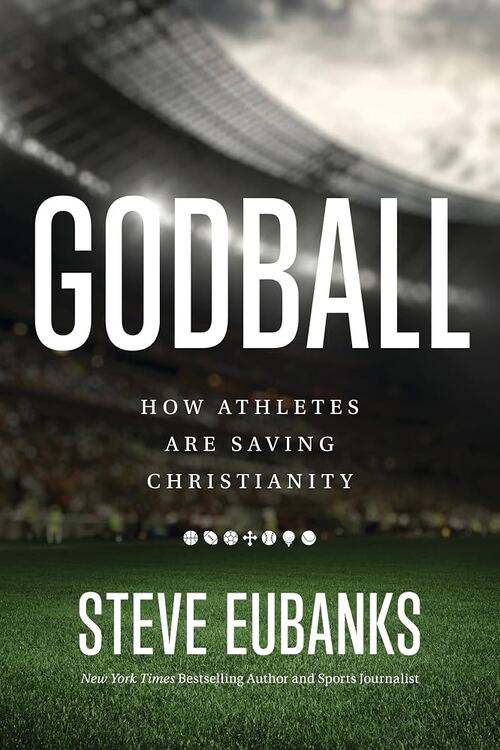
That being said, the overall gist of the book is great. Eubanks argues that we are seeing a significant increase in the number of athletes who are declaring faith in Jesus, along with an increase in the boldness of their witness. Apparently, in the last five years, there has been something like an 800% rise in the mentions of God or Jesus in sports telecasts. The book is full of conversations with Christian athletes and anecdotes about how those athletes have shared their faith, especially through newer ways like social media. Many figures interviewed in the book point to the widespread cultural darkness and confusion since 2020 as a major turning point. Eubanks believes the change among athletes has been so drastic that it constitutes a revival, bordering on a revolution, that is beginning to make an impact beyond the sports world. This is definitely something that we can praise God for and ask Him to keep doing! Here are three takeaways from the book that stand out to me:
Winning as secondary
The first takeaway is that for many of these Christian athletes and coaches, winning has become relativized. It’s no longer the most important thing. Rose Zhang, a successful professional golfer, points this out: “there were a lot of wins that I had as an amateur, and I have no idea who has won (those tournaments) since. Those wins might be life changing for the person who won them, but I’ve moved on and don't know. That’s how other people look at my wins now, and how we all look at wins and losses five years from now. You need something more, something fulfilling and sustaining. I hope everyone finds that in God.” That’s so true, isn’t it? I’m a big sports fan, but I can’t tell you who won the NCAA basketball championship a couple of years ago, never mind 10 years ago. That kind of victory is inevitably short-lived and fleeting. Scottie Scheffler, the world’s top male golfer and an outspoken believer, has said similar things in some of his recent press conferences.
But there are things that are lasting. Eubanks tells the story of Jaccob Slavin, one of the best defensemen in the NHL, leading a teammate named Jalen Chatfield to faith in Jesus. Slavin says, “if I go my whole career and never win a Stanley Cup, (Jalen) coming to the Lord was way more important- way more worth it, so much more fulfilling than what winning a Stanley Cup would bring.” I love that. So many of these athletes are recognizing that their abilities and realms of influence are a unique opportunity to see people come to eternal life, something of infinitely more value than winning a sports game.
Winning as a by-product
That leads to a second takeaway. While winning is no longer primary, that doesn’t mean it stops happening. One of my favourite quotes in the book comes from a football coach at North Dakota State University, a school that has won 10 national championships in the last 15 years- an incredible run of dominance. Defensive co-ordinator Grant Olson says, “I know a lot of our coaches who were not Christians but are now who tell me that the movement toward Christ was what launched us to our run of national championships; not because God loves us more than the other teams, but because the character of our teams improved dramatically. We became better teammates; we became more selfless and harder workers; we sold out for each other and for something greater than ourselves. And then we just happened to start winning national championships.”
I absolutely love that. Becoming Christians didn’t mean that coaches and athletes stopped working as hard, or that they quit being competitive, or that they tried to play non-contact football. They continued to play their sport to the best of their ability, but following Jesus meant that their character had been transformed. Players no longer played for themselves, but played for one another. They actually become harder workers, more disciplined and self-controlled. This was all a result of faith in Jesus, and in the process the team became better. “We just happened to start winning national championships.” I think there’s something here for all of us, athletes or not. Whatever kind of work we do, we are to do that work as Christians, conformed to the character of Christ. When that’s our goal, the other stuff we used to live for (like success) may come naturally, as a by-product. We are no longer forcing it, success is no longer our idol, and so it can emerge organically. Maybe it’s a bit of that “seek first the kingdom of God and his righteousness, and all these things will be added to you as well” kind of thing.
Athletes as relatable witnesses
Finally, it hit me as I read through this that one of the reasons athletes may be such powerful witnesses is because of how relatable they are. Now, in one sense that sounds totally wrong, because professional athletes play a sport for a living and become multi-millionaires in the process. If I look at a professional football or basketball player, they seem like they belong to another species, physically speaking. None of that is “relatable”. What I mean, though, is that these Christian athletes aren’t philosophers. They’re not trained theologians. They’re not academics. They’re not delving into divisive areas of controversy. Their statements about faith are often short and simple. Eubanks writes about these athletes that “at best, most would make passable Sunday School teachers…that is one of the biggest reasons people have been drawn back to Christ through his modern athlete-driven revival, and why many in and out of church life believe the movement is divinely inspired. Like Christ and his apostles, athletes relate to their audience. They speak the language, and, to use a modern description, they project the right vibes.”
We need witnesses of all shapes and sizes, including academic ones who have dug deep and thought thoroughly about Christian faith- my book review next week will get at that. But what Godball gets is that these athletes have a massive platform because of their status while also being able to speak in the language of everyday people when it comes to faith. The Lord uses that. He is using that. It’s an important lesson to learn for people like me who, because of how long I’ve been a Christian and the amount of study I’ve done, can sometimes forget how to translate all of this in a language people can understand.
God is doing something through His “athlete-servants”. May it continue to be, and may it overflow to all who hear their testimonies!
Winning as secondary
The first takeaway is that for many of these Christian athletes and coaches, winning has become relativized. It’s no longer the most important thing. Rose Zhang, a successful professional golfer, points this out: “there were a lot of wins that I had as an amateur, and I have no idea who has won (those tournaments) since. Those wins might be life changing for the person who won them, but I’ve moved on and don't know. That’s how other people look at my wins now, and how we all look at wins and losses five years from now. You need something more, something fulfilling and sustaining. I hope everyone finds that in God.” That’s so true, isn’t it? I’m a big sports fan, but I can’t tell you who won the NCAA basketball championship a couple of years ago, never mind 10 years ago. That kind of victory is inevitably short-lived and fleeting. Scottie Scheffler, the world’s top male golfer and an outspoken believer, has said similar things in some of his recent press conferences.
But there are things that are lasting. Eubanks tells the story of Jaccob Slavin, one of the best defensemen in the NHL, leading a teammate named Jalen Chatfield to faith in Jesus. Slavin says, “if I go my whole career and never win a Stanley Cup, (Jalen) coming to the Lord was way more important- way more worth it, so much more fulfilling than what winning a Stanley Cup would bring.” I love that. So many of these athletes are recognizing that their abilities and realms of influence are a unique opportunity to see people come to eternal life, something of infinitely more value than winning a sports game.
Winning as a by-product
That leads to a second takeaway. While winning is no longer primary, that doesn’t mean it stops happening. One of my favourite quotes in the book comes from a football coach at North Dakota State University, a school that has won 10 national championships in the last 15 years- an incredible run of dominance. Defensive co-ordinator Grant Olson says, “I know a lot of our coaches who were not Christians but are now who tell me that the movement toward Christ was what launched us to our run of national championships; not because God loves us more than the other teams, but because the character of our teams improved dramatically. We became better teammates; we became more selfless and harder workers; we sold out for each other and for something greater than ourselves. And then we just happened to start winning national championships.”
I absolutely love that. Becoming Christians didn’t mean that coaches and athletes stopped working as hard, or that they quit being competitive, or that they tried to play non-contact football. They continued to play their sport to the best of their ability, but following Jesus meant that their character had been transformed. Players no longer played for themselves, but played for one another. They actually become harder workers, more disciplined and self-controlled. This was all a result of faith in Jesus, and in the process the team became better. “We just happened to start winning national championships.” I think there’s something here for all of us, athletes or not. Whatever kind of work we do, we are to do that work as Christians, conformed to the character of Christ. When that’s our goal, the other stuff we used to live for (like success) may come naturally, as a by-product. We are no longer forcing it, success is no longer our idol, and so it can emerge organically. Maybe it’s a bit of that “seek first the kingdom of God and his righteousness, and all these things will be added to you as well” kind of thing.
Athletes as relatable witnesses
Finally, it hit me as I read through this that one of the reasons athletes may be such powerful witnesses is because of how relatable they are. Now, in one sense that sounds totally wrong, because professional athletes play a sport for a living and become multi-millionaires in the process. If I look at a professional football or basketball player, they seem like they belong to another species, physically speaking. None of that is “relatable”. What I mean, though, is that these Christian athletes aren’t philosophers. They’re not trained theologians. They’re not academics. They’re not delving into divisive areas of controversy. Their statements about faith are often short and simple. Eubanks writes about these athletes that “at best, most would make passable Sunday School teachers…that is one of the biggest reasons people have been drawn back to Christ through his modern athlete-driven revival, and why many in and out of church life believe the movement is divinely inspired. Like Christ and his apostles, athletes relate to their audience. They speak the language, and, to use a modern description, they project the right vibes.”
We need witnesses of all shapes and sizes, including academic ones who have dug deep and thought thoroughly about Christian faith- my book review next week will get at that. But what Godball gets is that these athletes have a massive platform because of their status while also being able to speak in the language of everyday people when it comes to faith. The Lord uses that. He is using that. It’s an important lesson to learn for people like me who, because of how long I’ve been a Christian and the amount of study I’ve done, can sometimes forget how to translate all of this in a language people can understand.
God is doing something through His “athlete-servants”. May it continue to be, and may it overflow to all who hear their testimonies!
Recent
Archive
2026
February
March
May
2025
January
February
March
April
May
July
August
October
2024
January
February
March
April
May
June
July
August
September
October
Deleted Scenes: Why Paul wrote a letter to a church he didn’t knowDeleted Scenes: What's Your Constant Prayer? Romans 1:8-17Deleted Scenes: The Eye of the Tiger. 2 Chronicles 20:1-30Deleted Scenes: Strength when speaking a challenging truth. Romans 1:18-32Deleted Scenes: What October 31 is all about. Romans 2:1-16
November
No Comments